
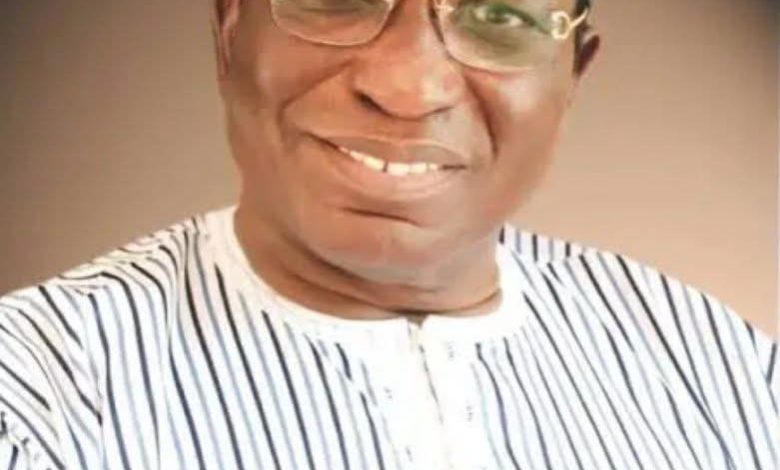
MARRIED TO PURPOSE: Sir Fidelis Tapgun at 85
There is a timeless nobility in a life entirely poured out for the common good. Across the grand, evolving tapestry of Nigeria’s democratic history, true leadership is measured neither by the sheer longevity of a title nor by the volume of partisan applause. Instead, it belongs to those rare, monumental figures who view power as a sacred trust, and the machinery of state as a dedicated vessel for human upliftment.
As we celebrate the glorious 85th milestone of His Excellency, Sir Fidelis Naanmiap Tapgun, CON, KSGG, KSM, we honor more than a remarkable span of years; we pay homage to a living monument of selfless patriotism, an enduring administrative colossus, and the legendary last civilian custodian of the undivided old Plateau State.
His life stands as a towering testament to an enduring political truth: that the highest calling of statecraft is not the celebration of the self, but an unyielding, generational commitment to humanity.
His Excellency stands as a monumental figure in Nigeria’s democratic journey.
Celebrating his 85th birthday, he continues to exude agility, a robust spirit, and a commanding presence. His tenure from January 1992 to November 1993, though lasting less than two years, remains an enduring masterclass in populist, people-centered governance.
Before his historic ascent to the governorship under the Social Democratic Party (SDP) platform, Tapgun’s leadership style was forged in the crucibles of relevant higher education and disciplined public service. As a 1974 political science graduate from Ahmadu Bello University, Zaria, he did not merely study the theories of power; he spent nearly three decades climbing the rigid ladders of the civil service, internalizing how policy translates into human welfare. Rising to the pinnacle of his career as a Permanent Secretary, these decades of administrative grit shaped his political persona.
He emerged not as a flamboyant, reactionary demagogue, but as a methodical, deeply empathetic administrator whose heartwarming character and leadership style were rooted in absolute dialogue, procedural rigor, and structural stability.
This bureaucratic mastery and deep understanding of political science became his ultimate wildcard when navigating one of the most peculiar, convoluted political experiments in Nigerian history: Gen.Ibrahim Babangida’s Third Republic transition. Operating within a hybrid, “jollof-like” diarchy where democratically elected state governors attempted to legislate under the overarching, heavy hand of a military presidency, the terrain was structural quicksand. It was a fragile facade of democracy under the sword of Damocles, yet Sir Fidelis managed to protect the welfare of the Plateau people with immense diplomatic finesse.
What makes his legacy so astonishing is how he transformed this complex, highly restrictive setup into rapid execution. In what was effectively a short span of active governance before the political landscape shifted, Tapgun achieved a series of masterstroke interventions that outshone administrations lasting a full eight years.
He expanded access to education by establishing over 30 new secondary schools, providing free textbooks, and fully absorbing WAEC and JAMB fees for all Plateau candidates. In healthcare, he completely abolished consultation and maternity fees for women in public hospitals. He pushed regional utility expansions like the foundational work for the Keffi water project, constructed the iconic Terminus Roundabout in Jos adorned with the famous “Mama Tapgun” statue, and maintained absolute ethno-religious harmony across the old state. Crucially, his vision extended heavily into human capital; he promoted youth activities and sports, using them as tools for unity and empowerment during a turbulent national era.
As the author of this tribute, I can testify firsthand to how his profound humility was practiced daily in the corridors of power. During his time as governor, a radical journalist friend of mine kept the young administration strictly on its toes, mounting an unrelenting, highly imaginative media campaign fueled by the heat of organized political rivalry. This constant, piercing criticism deeply infuriated the young, fiercely loyal die-hards in the government, who wanted to silence the critic and serve him a swift dose of “political justice.”
But Governor Tapgun, true to his gentle nature, utterly rejected any form of tyranny. Where others would have unleashed state machinery, he demanded conversation and consensus. Knowing my close personal relationship with the journalist in question, the Governor and his protective inner circle asked me to bring the fiery pen-merchant to a face-to-face meeting. We walked before the Governor, ready for a tense showdown, but His Excellency defused the entire crisis in a single, legendary sentence: “Feel free to report and correct what we do good or bad, but confirm from us when you imagine things about us.” With that profound display of open-mindedness, an adversarial relationship was permanently transformed into a shared understanding—a masterclass in peaceful tolerance that modern leaders would do well to study.
No leadership chronicle is complete without nuance, and critics have frequently pointed to the controversial privatization and sale of the state-owned Brewery Agro Research Company (BARC) Farms. While subsequent administrations spent decades trying to recover the asset, a fair historical autopsy reveals this decision was not born out of a lack of vision. On the contrary, it was a deliberate, progressive economic strategy designed to offload a capital-intensive enterprise from the state’s balance sheet, transferring it into capable private hands to stimulate commercial efficiency and relieve the public treasury. Furthermore, his later years as a prominent Peoples Democratic Party (PDP) Board of Trustees member occasionally saw his blunt, uncompromising truths label him a polarizing elder statesman during intense internal party friction.
Yet, his post-gubernatorial career only solidified his stature as a national asset and revealed an extraordinary second act: transitioning from an elected leader to a rare, influential kingmaker on the national stage. His peerless organizational capability was recognized at the highest levels when he was appointed the Director-General of the strategic Obasanjo/Atiku Presidential Campaign Organisation between 2002 and 2003, successfully steering the sweeping reelection of the presidency. He subsequently served the nation with unblemished integrity on the global stage as Nigeria’s High Commissioner to Kenya, and later within the federal executive as a Cabinet Minister heading the Ministry of Industry.
Even with this immense national portfolio, his heart never left home. Returning to his beloved home state, Tapgun deployed his political capital and grassroots goodwill to superintend over the historic election of Governor Jonah David Jang, cementing his legacy as a selfless architect of leadership successions.
Decades after stepping down from active governance, beneficiaries of his foundational free education policies still affectionately refer to themselves as “Tapgun’s children.”
Perhaps the most profound testament to his character is his choice of lifestyle. In a political culture where elites routinely migrate to high-brow, gated enclaves as a vainglorious mark of status, Sir Fidelis consciously chose to remain in his original neighborhood and old community. Living there with immense grace and dignity as a devout Catholic, he remains deeply anchored to his faith and community values. By living shoulder-to-shoulder with the very people he served, he shattered the traditional barriers of elite insulation.
At 85, Sir Fidelis Tapgun stands tall, untouched by the scandals that have caught many of his contemporaries—a living reference point for exemplary leadership. His trajectory offers an exquisite blueprint of power balanced by humility, and authority softened by humanity. He proved to a nation often weary of its leaders that true greatness does not lie in the preservation of personal power or ostentatious living, but in the deliberate elevation of others.
In fact, there is a powerful beauty hidden in this decision to live simply and stay down-to-earth among his people. While his contemporaries spent their post-political years stressing over property values in Abuja high-brow enclaves or nursing the high blood pressure that comes with maintaining a fake elite status, Sir Fidelis chose the ultimate wellness routine: genuine peace of mind, community love, and daily walks in the old neighborhood.
It is no wonder that at 85, His Excellency is looking incredibly fit, remarkably radiant, and structurally sound. Looking at him today, he is so agile that you would easily mistake him for someone about to embark on a fresh, rigorous campaign trail!
Of course, having successfully transitioned from an elected leader to an unmatched national kingmaker, His Excellency has absolutely nothing left to prove on a ballot paper. Though looking at how fresh and robust he is, he could easily give many current office seekers a serious run for their money in a fitness test! Clearly, a life of simple humility and profound faith is the ultimate fountain of youth.
As we mark this glorious milestone, we join millions of well-wishers across the length and breadth of Nigeria in celebrating an exceptional icon of selfless service.
May your days continue to be blessed with robust health, infectious joy, and the peaceful fulfillment. Thank you for showing us that leadership is, above all, a commitment to humanity.
Happy 85th Birthday, Your Excellency!.
Soknan Shedul Ishaku.
Media Specialist,
National Coordinator of the Congress of Minorities of Northern Nigeria (CMNN)
Writes from Abuja.
soknanshedulishaku@gmail.com


