
By Aminu Garko
Kano – July 23, 2026 – Kano State’s education reforms have received international recognition at the Parliament of the United Kingdom, where global education leaders commended Governor Abba Kabir Yusuf’s commitment to transforming the sector through sustained investment, policy reforms and improved learning outcomes.
This was contained in a statement issued on Thursday by the governor’s spokesperson, Sunusi Bature Dawakin Tofa.
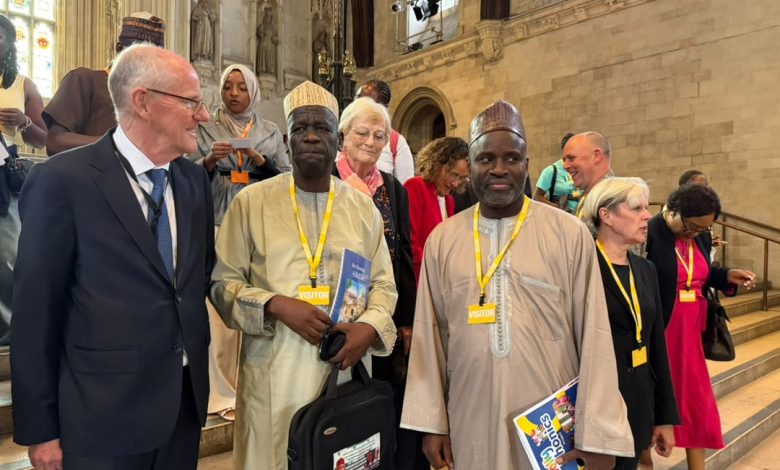
The recognition came during an International Parliamentary Forum on Reading Revolution held at the House of Lords, Westminster, London, on July 23, 2026.
The event was supported by Universal Learning Solutions, ULS, an international non-governmental organisation implementing the Jolly Phonics Project in Nigeria to improve literacy and reading skills in formal and integrated schools.
Speaking at the forum, the Chief Executive Officer of Universal Learning Solutions, Gary Foxcroft, praised Governor Yusuf for transforming Kano’s education system through visionary leadership, sustained funding and the creation of an enabling environment for reforms to thrive.
The roundtable was hosted and chaired by Lord Alton of Liverpool, who said Nigeria and the United Kingdom shared common interests and values.
He noted that Kano State’s adoption of England’s reading and literacy model was a strategic decision that would significantly improve learning outcomes among children.
In his keynote address, Nick Gibb, the United Kingdom’s longest-serving Minister of State for Schools, said the Kano State Government had demonstrated an ambitious commitment to transforming its education sector.
Representing Governor Yusuf, the Technical Adviser on Education Reform, Haladu Mohammed, told the British Parliament that education remained the number one priority of the present administration.
He said Kano continued to allocate the highest proportion of its annual budget to education as part of efforts to rebuild the sector.
He disclosed that Kano currently had about five million pupils enrolled in schools across the state.
According to him, the state had over 8,000 formal schools and more than 14,000 Qur’anic schools that were being integrated into the formal education system.
He also noted that Kano still faced the challenge of over one million out-of-school children, making education reforms a top government priority.
Dr Mohammed explained that the state required about 84,000 additional teachers to meet its growing educational needs.
He, however, revealed that the present administration had recruited about 20,000 new teachers within the last three years to reduce the manpower gap.
He further informed the forum that the government had introduced a new Teacher Development Policy under which teacher recruitment was based on the specific needs of individual communities.
He added that the government had also designed an Accelerated Basic Education Programme to provide learning opportunities for over-age out-of-school children and integrate pupils from Qur’anic schools into the formal education system.
In a message delivered on his behalf, Governor Yusuf reaffirmed his administration’s commitment to restoring Kano’s educational excellence.
“Kano will spare no resources until the education sector is fully restored to its rightful place,” the governor said.
The Commissioner for Religious Affairs, Ahmad Tijjani Sani Auwal, said the integration of Islamic schools would provide an opportunity to increase literacy and numeracy in Kano communities.
He appreciated the British Parliament for the opportunity to discuss the successes recorded by the present administration of Governor Yusuf.
The meeting was attended by education experts in the United Kingdom and Nigerians in the diaspora, including Hindy Mohammed, Amina Abubakar, Pauline Dixon and Steve Humble of Newcastle University.
The international recognition at the UK Parliament reflects growing global confidence in Kano State’s education reforms and reinforces the state’s position as a reference point for educational transformation in Nigeria and beyond.


