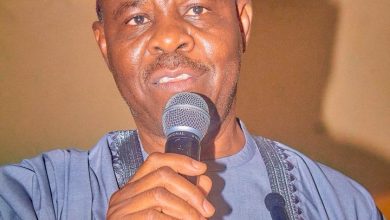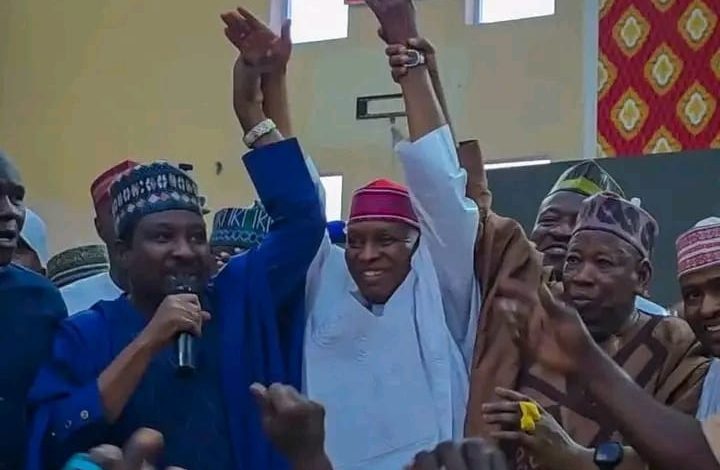
The battle for Government House in Kano has effectively begun. The political fallout between the current governor, Abba Kabir Yusuf, and his political mentor, Senator Rabiu Musa Kwankwaso, continues to shape discussions about the future direction of Kano’s political landscape ahead of the 2027 election cycle.
The symbolic replacement of the NNPP flag at Government House with that of the APC has created a profound shift in the state’s political trajectory. This development has unsettled the political order established by the Kwankwasiyya Movement, which overwhelmingly defeated the APC in the last general election.
The defection of Governor Abba Kabir Yusuf to the APC has deeply unsettled the Kwankwasiyya Movement, which had decisively routed the ruling party at the polls. Many supporters now feel abandoned, uncertain about the direction the state government is pursuing. This has generated widespread debate about which manifesto the current administration is implementing—NNPP’s campaign promises or those of the APC, a party that was rejected across almost all elective offices in the state.
Amid this political realignment, speculation is rife that the NNPP has returned to the drawing board to re-strategize and engineer a political comeback capable of restoring its dominance.
Kano remains a deeply religious and conservative society, where the influence of the Ulama significantly shapes political and social discourse. Against this backdrop, the growing conversation around a possible Malam Ibrahim Khalil–Malam Aminu Daurawa gubernatorial ticket has gained remarkable traction within the political space.
Senator Kwankwaso’s political influence and extensive grassroots following remain formidable. His political machinery, deeply entrenched among the masses, cannot be dismissed lightly. Since the return of democracy in 1999, this structure has proven resilient and enduring, surviving repeated political realignments.
Kwankwaso’s strength is rooted in his achievements in education, infrastructure, agriculture, and healthcare during his two tenures as governor. These accomplishments continue to resonate strongly with the electorate, reinforcing the belief that wherever Kwankwaso leads, the majority of Kano voters are likely to follow.
A ticket pairing Malam Ibrahim Khalil with Malam Aminu Daurawa would significantly broaden political appeal and strengthen NNPP’s chances of securing an overwhelming victory. Such a combination would attract both religious leaders and grassroots supporters, creating a formidable electoral force.
History supports this reasoning. The unbroken two-term tenure of Malam Ibrahim Shekarau was largely anchored on the overwhelming support of the Ulama. Their influence remains decisive in Kano’s political calculations.
Consequently, a Malam/Malam ticket enjoys strong prospects, particularly in the context of the political marginalization Kwankwaso experienced after mobilizing, campaigning, and securing victory, only for the political dividends to seemingly shift elsewhere. This perceived betrayal is likely to generate significant sympathy votes for NNPP.
Moreover, a Khalil–Daurawa ticket would likely neutralize sectarian divisions between Darika and Izala for the broader collective interest. The Ulama would not merely serve ceremonial roles but would actively participate in governance, shaping policies that directly affect the lives of over ten million people in the state.
Under such circumstances, even the intervention of the APC’s national leadership may prove insufficient to tilt the balance in favour of Governor Abba Kabir Yusuf, should the Malam/Malam ticket make it to the ballot.
⸻
Mahmud Shuaibu Ringim
📧 mahmudshuaibu44@gmail.com