
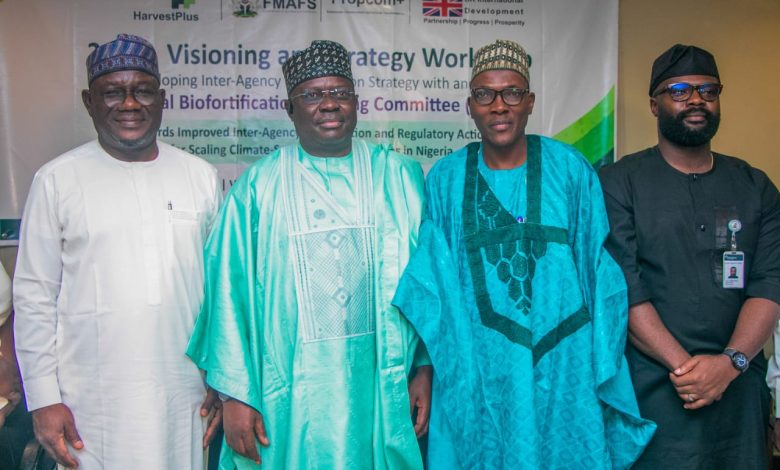
By Aminu Garko
Kano, The Federal Government has reaffirmed its commitment to strengthening food and nutrition security through expanded adoption of biofortified crops across the country.
The Permanent Secretary, Federal Ministry of Agriculture and Food Security, Dr. Marcus Olaniyi Ogunbiyi, stated this at a national biofortification workshop in Kano.
Ogunbiyi said that ensuring food availability alone was no longer sufficient, stressing the need to guarantee that food consumed by Nigerians was nutritious, safe, affordable and accessible.
He noted that malnutrition and micronutrient deficiencies remained major public health and economic challenges in the country.
According to him, biofortification provides a cost-effective and sustainable approach to improving nutrition, particularly among women, children and vulnerable groups.
He said the workshop was organised to review the mandate and operational framework of the National Biofortification Steering Committee and align it with national food and nutrition policies.
Ogunbiyi urged stakeholders to strengthen collaboration across agriculture, health, environment, education and private sector institutions to ensure effective implementation of biofortification programmes.
Also speaking, the Country Manager of HarvestPlus, Mr Yusuf Dollah, said Nigeria currently has the largest portfolio of biofortified crops globally.
Dollah said the country had developed and promoted iron-rich pearl millet, zinc-enriched rice, Vitamin A cassava, Vitamin A maize and Vitamin A sweet potato through partnerships with research institutions.
He explained that the initiative was designed to improve access to nutritious foods in rural communities where most households depend on farm produce for consumption.
He said biofortification had been integrated into national agricultural and nutrition policies in collaboration with relevant ministries and state governments.
Dollah said private sector participation had strengthened the value chain through seed multiplication, processing and market development.
According to him, Vitamin A maize accounts for about 70 per cent of coloured maize varieties cultivated in Nigeria, while iron-rich pearl millet constitutes about 60 per cent of millet varieties in circulation.
He added that more than 21 varieties of Vitamin A maize, nine varieties of Vitamin A cassava, four varieties of iron-rich millet and two varieties of zinc rice had been released for cultivation.
Dollah, however, identified limited diversification of some seed varieties and funding constraints for testing new crop lines as challenges affecting expansion efforts.
In his remarks, the Vice President of the Seeds Entrepreneurs Association of Nigeria, Sir Christopher Nwabudo, said the workshop was critical to advancing the Federal Government’s biofortification agenda.
Nwabudo said the forum provided stakeholders with the opportunity to review progress in the biofortification of major staple crops, including rice, maize, cassava and potatoes.
He expressed optimism that the workshop would develop workable strategies to address challenges related to seed availability, market acceptance and production scale.
Participants at the workshop emphasised the need for sustained investment in research, extension services and awareness creation to accelerate the adoption of biofortified crops nationwide.


